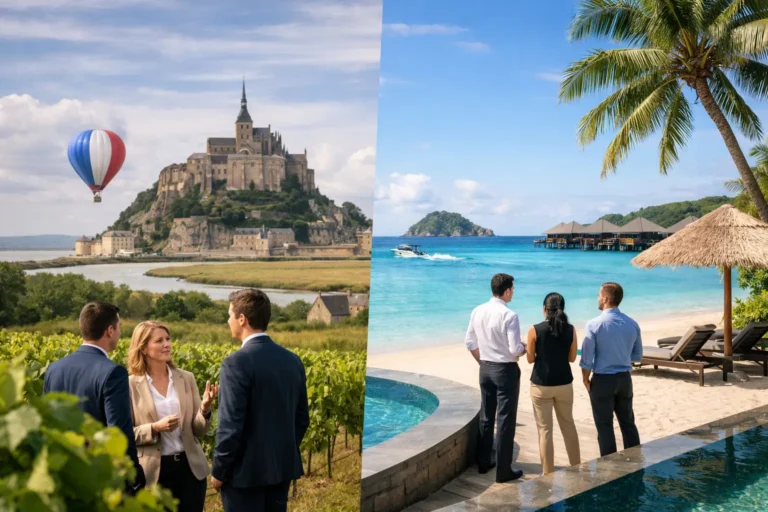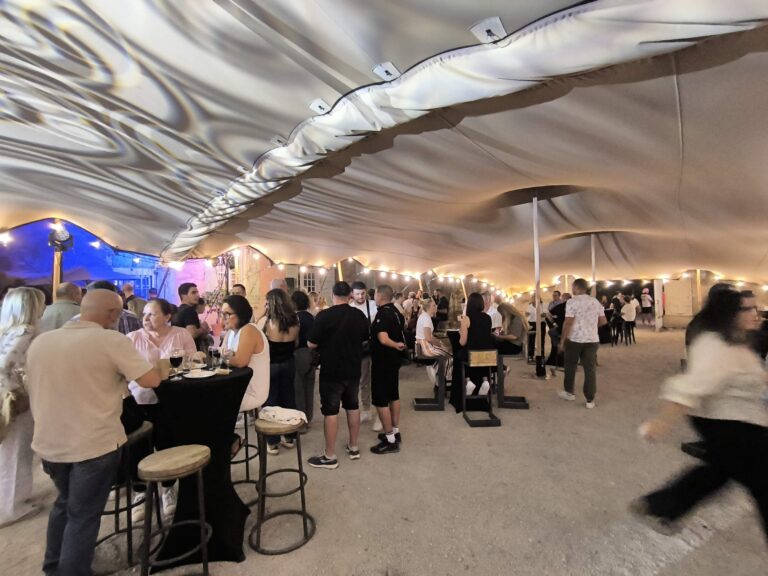

A seminar for 80 staff members at a Provençal estate, an end-of-year party for several sites, or an incentive trip abroad is never simply a matter of booking a venue. Behind the experience enjoyed by participants lie a managerial objective, brand image, a budget and a series of operational decisions. The question of in-house management or a local DMC therefore deserves more than a decision based solely on apparent cost.
The right choice depends on the nature of the event, the resources actually available in-house and the expected standard of quality. An event organised by your own teams can be highly appropriate in certain cases. Using a DMC, on the other hand, provides a management framework, practical expertise and the ability to take care of the details that make all the difference on the day.
In-house management or a DMC : the real issue
In-house management offers an immediate advantage: your teams are familiar with the company’s culture, its practices and the people who will be attending the event. For a simple, regular event of a manageable size – such as an annual meeting on your own premises or a team lunch – this familiarity may be sufficient. It also allows for a high degree of responsiveness in communications and last-minute adjustments.
However, organising in-house does not necessarily mean the event will cost less. The supplier budget is only part of the equation. You must factor in the time spent on research, calls for tenders, negotiations, contract monitoring, managing registrations, coordinating transport, dealing with special requests, handling unforeseen issues and providing on-site operational support. When several people devote a significant amount of their time to this, the indirect costs quickly become a reality.
This is precisely where a DMC comes in. Its role is not to take the event away from the company, but to transform a brief into a coherent and well-managed programme. It structures the project, selects the right partners, coordinates stakeholders and ensures that the original intention remains evident at every stage of the participant’s journey.
Start with the objective, not the format
The decision-making process should not begin with the question ‘who is organising it?’, but with another: ‘what is this event intended to achieve?’. A seminar designed to support a corporate transformation does not require the same level of planning as a sales conference. A team-building exercise aimed at bringing together two recently merged teams calls for particular attention to group dynamics. A client evening directly impacts the perception of your brand.
When the stakes are strategic, emotional or reputational, external support becomes all the more valuable. A DMC can challenge the initial format, propose a tailored programme and develop a unifying theme. For example, a working meeting in Provence can become a team-building seminar centred around periods of reflection, an activity rooted in the local area and a unifying dinner at a venue with a strong sense of identity. The setting is not merely a backdrop: it serves the objective.
Conversely, if the format is already tried and tested, if the suppliers are known and if your teams’ availability is confirmed, managing the event in-house can be effective. The decisive factor remains the ability to maintain the desired level of quality without compromising the priority tasks of the staff involved.
The four criteria to help you decide
The time actually available
An event requires ongoing management. Between the initial briefing and the debrief, there are numerous tasks to deal with: approvals, follow-ups, changes to guest numbers, dietary requirements, delayed arrivals, budgetary decisions or weather considerations. A competent in-house team that is already tied up with its HR, communications or sales duties risks having to organise the event under time pressure.
The DMC provides a dedicated resource and a single point of contact capable of centralising information. This reduces back-and-forth communication, minimises grey areas and allows your teams to retain their decision-making role rather than becoming logistics coordinators.
Operational complexity
The number of participants alone is not enough to gauge a project’s difficulty. A group of 30 people travelling from different cities, involving transfers, accommodation, plenary sessions, catering, activities and confidentiality requirements, may require more management than an evening event for 150 people at a single venue.
As soon as an event involves several service providers or comprises multiple stages, coordination becomes a specialism in its own right. The DMC draws up a reverse schedule, clarifies responsibilities, anticipates technical dependencies and ensures consistency amongst all parties involved. This approach safeguards the quality of execution, as well as the peace of mind of in-house teams.
Budget management
In-house organisation can sometimes give the impression of more direct control. However, rates, cancellation terms and room for negotiation depend largely on market knowledge and the scale of operations. An experienced DMC knows how to identify areas worthy of investment and those that can be optimised without compromising the experience.
Effective budget management is not about cutting every line item. It involves allocating resources where they create value: a venue genuinely suited to your objective, seamless catering, reliable technical production, realistic travel times, or entertainment that truly engages participants. A clear proposal should help you understand the choices made and retain control over trade-offs.
The expected level of personalisation
A standardised invitation, an interchangeable programme or an activity unrelated to your corporate culture can undermine the impact of an event, even one that is perfectly organised. The more you expect a distinctive experience, the more crucial the design work becomes.
A DMC brings ideas, of course, but above all the ability to make them a reality. It translates your messages into journeys, atmospheres and sequences. For a company wishing to thank its teams after a demanding year, this might take the form of an elegant and warm event. For a senior management team bringing its managers together to discuss a new roadmap, the experience must encourage buy-in and meaningful discussions. Personalisation is measured by the appropriateness of the choices made, not by the accumulation of gimmicks.
The often underestimated risks of in-house organisation
In-house organisation can run smoothly until the unexpected occurs. A speaker cancels, a transfer is delayed, the room layout does not match the planned layout, or adverse weather forces a change to an outdoor segment. These situations are not unusual; they are part and parcel of event management.
The difference lies in having alternatives prepared and in the ability to make quick decisions on the ground. A DMC has procedures in place, supplier contacts and a comprehensive understanding of priorities. It can handle a problem without participants realising the full extent of it. This is particularly valuable for events attended by senior executives, clients or international teams.
The human factor must also be taken into account. Asking a staff member to deal with unforeseen issues whilst they are supposed to be participating, facilitating or representing the company creates unnecessary stress. On the day itself, in-house teams must be able to enjoy the event and be available for their guests.
The hybrid model: retain the vision, outsource the execution
The choice is not always black and white. Many companies adopt a hybrid model, which is often highly effective. They retain in-house responsibility for defining objectives, key messages, programme approval and relations with participants. They entrust the DMC with venue sourcing, contract management, production, logistics and on-site coordination.
This division of responsibilities preserves your in-house knowledge of the company whilst drawing on dedicated event expertise. It is particularly well-suited to HR, communications or office management departments that wish to remain closely involved without shouldering the operational burden alone.
To ensure this process runs smoothly, the initial brief must be precise. It must specify the target audience, the number of participants, the indicative budget, the primary objective, any scheduling constraints and the criteria for success. The DMC can then propose a realistic plan that is consistent with your corporate culture and tailored to your ambitions.
Choosing a DMC as a project management partner
Not all agencies meet the same needs. For a B2B event, look first and foremost for the ability to listen, a clear methodology and a practical grasp of execution. Creativity is essential, but it must be accompanied by rigour: budgetary transparency, the appropriate selection of service providers, a shared reverse schedule and an appropriate operational presence.
Expertise in a particular destination can also add real value. In Provence, in-depth knowledge of venues, journey times, seasons and local experiences enables us to design programmes that make sense, without resorting to conventional formats. For projects outside the region or internationally, the same level of precision remains essential: an inspiring event only makes an impact if it is perfectly orchestrated.
Oleis Travel Events supports this approach from start to finish, from strategic planning to on-the-ground coordination, so that your company can focus on what matters most: the relationship with its teams, clients and partners.
The best choice will be the one that gives your staff the freedom to convey your message, whilst making your participants feel that every detail has been thought out with them in mind.